Princess Mary Tudor
The King's CursePrincess Mary Tudor, daughter of Henry VIII and Katherine of Aragon, is raised by Margaret Pole and becomes a central figure in the succession crisis surrounding her parents’ marriage. Her story traces a passage from childhood dependence and public ceremony to political isolation and a deliberate insistence on her birthright. As Henry VIII claims authority over the Church and alters the status of his family, Mary must contend with competing demands of filial obedience, religious allegiance, and royal legitimacy.
Identity and Early Place at Court
Mary’s position is shaped from the beginning by the uncertainty surrounding the Tudor succession. Katherine of Aragon has lost several children, and the survival of a male heir remains a persistent hope at court. When the queen is in labor, Margaret Pole reflects that a son would silence those who call Katherine weak or cursed and restore her standing against the king’s other companions. Mary, then two, is already flourishing in her nursery, but the court’s hopes remain fixed on the possibility of a boy. The birth of a son who dies shortly afterward only sharpens the importance attached to Mary’s place in the royal family.
Margaret is more than a court attendant to Mary. She has been appointed her governess and describes teaching her to read Latin, English, Spanish, and French, guiding her first steps, helping her learn to ride, and sharing music lessons. When Henry VIII orders Margaret dismissed, Katherine tells her the news at dawn after prayer. Margaret is devastated at the prospect of leaving a five-year-old child she loves and believes will be lost without her. The order removes Mary’s familiar guardian at a moment when the queen’s own position is increasingly precarious.
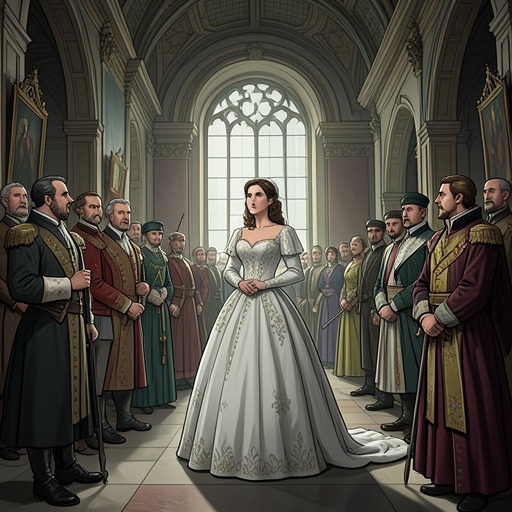
Mary’s public role is also expressed through ceremony and clothing. For the masque planned around her betrothal to France, she wears an exceptionally costly gown embroidered with rubies and pearls, with emerald stems and yellow-diamond centers evoking the Tudor rose. The dress is heavy enough to make her stagger at first, but Margaret sees her stand as a radiant princess. The scene presents Mary as a dynastic figure whose appearance carries the symbolism and material display of the royal house.
Family Bonds and the Pressure of Legitimacy
Mary’s relationship with Katherine is affectionate and visibly close. At Christmas 1529, Margaret brings Mary by royal barge to Greenwich Palace, where the girl runs through the presence chamber to her mother. The two embrace after a long separation. Katherine thanks Margaret for raising a beautiful daughter, and Margaret is moved by their reunion. Their closeness gives Mary an emotional bond that later political decisions threaten to sever.
Henry VIII’s efforts to end his marriage to Katherine place Mary’s identity under direct pressure. In a conversation with his daughter, he presents his actions as right for Mary, the kingdom, and her mother, and claims that God speaks directly to kings. He says those who oppose him oppose God’s will, while accusing Katherine of acting from ambition. Mary is visibly torn between loyalty to her mother and the force of her father’s authority. She answers with obedience in that moment, but the scene does not settle the conflict: it shows the personal strain created when a daughter is asked to accept her father’s political account of her family.
The conflict also reaches back to disputed claims about Katherine’s first marriage to Arthur Tudor. Margaret is challenged over whether she witnessed evidence that Katherine and Arthur’s marriage was consummated and is pressed to support the claim that Katherine’s marriage to Henry is invalid. The dispute matters directly to Mary because the validity of her parents’ marriage underlies her own legitimacy. The argument is not simply about private knowledge; it becomes a contest over which authority can define a royal marriage and determine the status of its child.
Mary as Witness to Political Change
As Mary grows older, she becomes less willing to be kept outside the decisions that affect her. At sixteen, she refuses Margaret’s instruction to go into the palace when Montague arrives with news. She asks to hear him herself, saying she is old enough, and insists that he tell them both what has happened. Her response marks a change from the child Margaret guided to a young woman who claims the right to understand events shaping her future.
Montague reports that the Church has surrendered to Henry VIII: the king will rule it himself, and the Pope is to be disregarded in England. He also tells them that Thomas More has resigned as Lord Chancellor. Mary grasps the scale of the change, asking whether the king has taken the Church’s wealth, laws, and courts into his own possession. Margaret and Montague cannot contradict her assessment. Mary is not merely receiving family news; she recognizes that the struggle over ecclesiastical authority is also a struggle over the limits of royal power.
Montague proposes resistance to protect Katherine and Mary, fearing that Henry’s promotion of Henry FitzRoy as an heir will push Mary aside. His plan involves Geoffrey Pole carrying information and messages abroad, including an appeal for the Pope to intervene. Margaret’s account makes clear that the family’s close intermarriage can be understood in two opposing ways: as a source of shared loyalty and support, or as evidence of a faction. Montague invokes the Plantagenet family’s claim to serve as a counterweight to Henry, while Margaret understands that defending Mary and Katherine may require her own family to act politically. Mary’s vulnerability is thus connected to a wider network of kinship and dynastic rivalry.
Confinement, Resistance, and an Unresolved Future
After Henry VIII’s marriage to Anne Boleyn is announced, Mary receives a short royal letter. Before opening it, she checks that it is properly addressed to Princess Mary, alert to the possibility that the message might diminish her status. She reads it without outwardly yielding to the moment and tells Margaret she will respond after dinner. The formal address preserves the title in that communication, but her caution shows how uncertain even its public recognition has become.
When the king’s demand reaches her more directly, Mary states that she will not disobey his commands but cannot renounce the rights given to her by God, nature, and her parents. She presents her identity as inseparable from her birth: she was born a Tudor princess and will die one. This is not a declaration that removes the danger around her; it is a refusal to let royal command erase her understanding of her own status.
The consequences are severe. At Hatfield Palace, Mary is confined to the house, barred even from walking in the grounds, and kept from visitors for fear they might bring her a message or comfort. Separated from Katherine and estranged from her father, she is reduced to preparing breakfast over her bedroom fire because she fears food from the palace kitchen may be poisoned. Margaret is forbidden to visit despite sending repeated pleas to Thomas Cromwell and seeking intervention from other courtiers. Her separation from Mary becomes a source of profound distress.
Mary’s trajectory ends in the evidence not with reconciliation or a resolution of her claim, but with an increasingly explicit defense of it. She has moved from a child formed by Margaret’s care, through a daughter caught between her parents, to a politically alert princess who understands that the Church, the crown, and her own inheritance are bound together. Her resistance is expressed in measured terms, but its stakes are fundamental: whether the king’s power can redefine her family and, with it, Mary herself.